
TANRUB · PRODUCT GUIDE
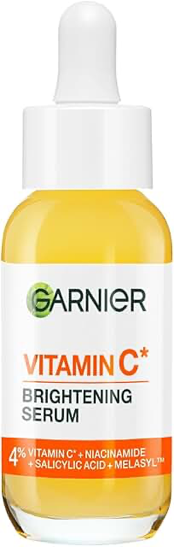
Garnier SkinActive Vitamin C Brightening Serum 30ml
Garnier Vitamin C Brightening Serum has changed across markets and versions. This guide separates the current Australian Melasyl reference from other formulas and explains the evidence behind its brightening claims.
As an Amazon Associate I earn from qualifying purchases. This is a research guide, not a personal product test.
Quick verdict
The important choice is the formula version, not simply the words “Vitamin C”. This catalogue records a 30ml serum under ASIN. The current Australian reference contains Melasyl, whereas other regional and older formulas differ. Check the seller’s rear label before assuming the current Australian research applies to the bottle supplied. This guide retains the catalogue identity; it does not claim to have inspected that seller’s batch.
Product at a glance
| Product | Garnier SkinActive Vitamin C Brightening Serum; recorded size 30ml. |
|---|---|
| Catalogue identifier | ; an identifier is not authentication of an individual bottle. |
| Format | Leave-on facial serum. It is not the separate SPF serum cream or 10% night serum. |
| Key buying check | Match range name, percentage statement, country label and full ingredients. |
| Testing status | Source-based research; Tanrub has not personally tested the serum. |
Why 4% does not mean 4% vitamin C
Garnier’s current Australian page describes a combined 4% complex of niacinamide, vitamin C derivative, salicylic acid and Melasyl. Individual concentrations are not disclosed there. The combined percentage cannot be assigned to each ingredient, and it does not establish a 4% salicylic-acid peel. A different regional product carries a combined 3.5% statement. Comparing those two headline numbers alone cannot rank their effectiveness.
Current Australian reference ingredients
Formula reference 967660 23; F.I.L. Z70046241/1. Ingredient names below reproduce the factual manufacturer declaration. They are a comparison reference, not a confirmed analysis of this ASIN’s current seller stock.
Aqua/Water, Glycerin, Alcohol Denat., Dipropylene Glycol, Butylene Glycol, Niacinamide, PEG/PPG/Polybutylene Glycol-8/5/3 Glycerin, Hydroxyethylpiperazine Ethane Sulfonic Acid, Isononyl Isononanoate, Ascorbyl Glucoside, Citrus Limon Fruit Extract/Lemon Fruit Extract, Potassium Hydroxide, 2-Mercaptonicotinoyl Glycine, Sodium Hyaluronate, Sodium Thiosulfate, Silica, Adenosine, Phenylethyl Resorcinol, Ammonium Polyacryloyldimethyl Taurate, Hydrogenated Lecithin, Caprylyl Glycol, Tetrasodium Glutamate Diacetate, Trisodium Ethylenediamine Disuccinate, Xanthan Gum, Tocopheryl Acetate, Salicylic Acid, Chlorphenesin, CI 15510/Orange 4, CI 19140/Yellow 5, Linalool, Geraniol, Limonene, Parfum/Fragrance.
Sources: [1]
Regional formula differences
The separate South African Even & Bright 3.5% reference declares 3-O-ethyl ascorbic acid, rather than ascorbyl glucoside, and does not list 2-mercaptonicotinoyl glycine. It also lists BHT and acetyl trifluoromethylphenyl valylglycine. Its directions specify 3–4 drops; these should not override a different bottle’s instructions. These are material formula differences, not proof that one bottle is counterfeit.
Do not combine ingredients from several web pages to create an imaginary “complete” formula. If your label differs, use that label and ask the brand about its formula code. A regional website can establish what the brand declares for that market; it cannot establish which batch an unrelated seller will dispatch.
Sources: [2]
Reading the ingredient panel
| Ascorbyl glucoside versus pure ascorbic acid | These are different named ingredients. A study of a particular pure-vitamin-C preparation cannot supply the missing strength or stability data for this derivative-containing serum. |
|---|---|
| Niacinamide and salicylic acid | Their presence does not reveal their individual percentages. Ingredient order is not a substitute for quantitative formulation data. |
| 2-Mercaptonicotinoyl glycine | Use the exact chemical name to identify the Melasyl reference; do not transfer its research to a label that lacks it. |
| Alcohol, parfum and fragrance components | This reference is not alcohol-free or fragrance-free. The list alone cannot predict an individual reaction. |
| Colour and scent | Neither indicates clinical potency. No validated home colour-change test for this serum’s remaining activity was located. |
Brand claims and their limits
The current Australian page attributes an “up to 70%” dark-spot claim at eight weeks and a three-day brightening claim to a 111-person cosmeto-clinical study using twice-daily application. Its public summary does not establish the average improvement, control-group result, confidence interval or persistence after stopping. An upper-bound marketing result is not a promised personal outcome, and a three-day appearance change is not complete clearance of pigmentation.
Sources: [1]
What niacinamide research actually tested
Hakozaki and colleagues’ 2002 paper included an 18-person paired comparison of 5% niacinamide moisturiser with its vehicle, plus a 120-person facial-tanning study involving vehicle, sunscreen and 2% niacinamide with sunscreen. Clinical improvements were reported after four weeks. Laboratory inhibition of melanosome transfer was a separate endpoint.
This supports research interest in niacinamide, but neither formula was this Garnier serum. Its undisclosed niacinamide percentage, combined ingredients and vehicle prevent a direct dose-for-dose comparison. The paper’s Procter & Gamble affiliation is relevant industry context, not a reason to equate it with a Garnier product trial.
Sources: [3]
What Melasyl research can establish
A 2025 primary publication describes two randomized controlled studies involving 58 people with phototypes III or IV. Test preparations contained 0.5% or 1% 2-mercaptonicotinoyl glycine, or 7% ascorbic acid, and examined pigmentation induced by high-energy visible light. This is a specific experimental exposure model, not a test of every cause of facial pigmentation.
The study does not establish this seller’s product composition. Nor can the listed test concentrations be assigned to a commercial serum with a combined percentage claim. A pigment endpoint also does not provide an SPF or show that sunscreen can be omitted.
Sources: [4]
Application and routine placement
For the current Australian Melasyl version, the brand describes one full dropper morning and night, after cleansing, with daytime sun protection and a moisturising step as needed. Follow the supplied pack when it differs. No reliable millilitre-per-dropper measurement was established, so this guide does not calculate an exact number of days per bottle.
Use the variant comparison above before borrowing directions. More applications or a fuller dropper have not been shown here to produce faster improvement. Avoid introducing several new actives together if you want to identify what caused any change in comfort.
Tolerance and combinations
AAD guidance recommends testing a new product on a small area twice daily for 7–10 days using its normal application method. Stop and wash it off if a reaction develops; persistent or severe symptoms merit professional assessment. Home testing is not the same as medical allergy patch testing and cannot guarantee future tolerance.
AAD also cautions that exfoliation alongside retinoids, retinol or benzoyl peroxide may increase dryness and irritation. There is no verified product-specific compatibility study here for every possible combination. Pregnancy, prescription treatment and active dermatitis questions should be checked against the exact label with an appropriate clinician.
Storage, expiry and packaging
The Australian brand recommends cool, dry storage away from direct sun. An exact temperature range, unopened expiry and period-after-opening value for the seller’s batch remain unverified. Read the carton and bottle symbols rather than assuming a universal 6- or 12-month life. Record the batch and formula code if you need to compare a replacement purchase.
Value and alternatives
For a single 30ml bottle, delivered price divided by 30 and multiplied by 100 gives cost per 100ml. Confirm unit count before comparing a bundle. A lower price for an older or regional formula is not a like-for-like price comparison unless that formula is the one you want.
| Separate Garnier 10% night serum | The Australian brand describes pure vitamin C at 10%; this is a different product, not another name for the combined-complex serum. |
|---|---|
| The Ordinary Niacinamide 10% + Zinc 1% | A different declared-active approach; compare its own product guide, rather than expecting identical results. |
| COSRX Snail 96 Essence | A separate essence format; sharing a routine category does not make the products substitutes for a diagnosed pigmentation condition. |
Sources: [7]
Frequently asked questions
Is this 4% pure vitamin C? No such individual concentration was verified. The current Australian percentage describes a combined complex.
Does every Vitamin C Brightening Serum contain Melasyl? No. The regional reference above demonstrates a different formula.
Does it replace sunscreen? No SPF claim was established for this serum.
Will it remove acne scars? A dark-mark appearance claim does not demonstrate repair of depressed or raised scars.
Can reviews establish which formula I will receive? Reviews may combine variants and dates. Ask for the current label rather than relying on a review photograph.
What remains unverified
The exact seller-batch label, individual active percentages, finished pH, independent assay of stability, complete protocol for the brand’s 111-person study, dropper volume and batch-specific expiry remain unresolved. These gaps are stated explicitly; the guide does not substitute another product’s measurements. The original catalogue image is retained and may show an earlier pack.
Sources and verification record
- Garnier Australia: current Melasyl serum, formula and study footnotes
- Garnier South Africa: separate 3.5% Even & Bright reference
- Hakozaki et al. 2002: niacinamide clinical and laboratory research
- 2025 randomized visible-light pigmentation trials: 2-MNG and ascorbic acid
- AAD: testing new skin-care products
- AAD: exfoliation and irritation
- Garnier Australia: separate 10% night serum
Research checked 14 October 2026. Manufacturer claims, primary ingredient research and seller-stock uncertainty are distinguished throughout.