
THE ORDINARY · PRODUCT GUIDE
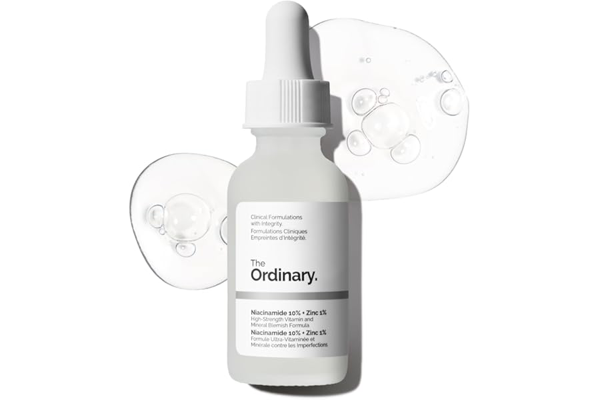
The Ordinary Niacinamide 10% + Zinc 1%
The Ordinary Niacinamide 10% + Zinc 1% is a water-based, leave-on serum. Explore its published composition, routine placement, compatibility advice and the limits of the evidence, with a separate check of the 30 ml catalogue entry.
As an Amazon Associate I earn from qualifying purchases. Tanrub has not personally tested this product.
Exact product and pack
| Detail | Verified reference |
|---|---|
| Brand / product | The Ordinary Niacinamide 10% + Zinc 1% |
| Format | Water-based leave-on facial serum |
| Key concentrations | 10% niacinamide; 1% zinc PCA, according to the brand |
| Manufacturer sizes | 30 ml and 60 ml |
| Catalogue entry | Indexed Amazon records identify a 30 ml bottle. Confirm the selected seller offer. |
| Published pH | 5.00–6.50; a manufacturer range, not a measurement of your bottle. |
The serum, a niacinamide powder and other niacinamide-containing moisturisers are separate formulations. The 10% and 1% figures do not mean the product contains 1% elemental zinc or that every niacinamide serum has comparable composition. Sources 1–2.
Full ingredient declaration
Aqua (Water); Niacinamide; Pentylene Glycol; Zinc PCA; Dimethyl Isosorbide; Tamarindus Indica Seed Gum; Xanthan Gum; Isoceteth-20; Ethoxydiglycol; Phenoxyethanol; Chlorphenesin.
This is the Australian manufacturer’s published reference, in its original order. The brand warns that the package may differ by purchase time and region. Percentages for the supporting ingredients are not disclosed. The list contains no named parfum/fragrance, but a list is not a personal allergy assessment. Source 1.
Niacinamide and zinc: what the evidence actually addresses
Niacinamide is a form of vitamin B3. The manufacturer describes this serum as targeting shine and uneven texture. Its educational material explains the inclusion of zinc PCA alongside niacinamide. These descriptions should be read as claims about a cosmetic serum, rather than a diagnosis or a guarantee that it treats every cause of acne. Source 3.
A 2006 study evaluated a 2% niacinamide moisturiser, rather than this 10% serum. It enrolled 100 people in a four-week Japanese comparison and 30 people in a six-week US split-face study. Some sebum measures improved, but the results differed between the populations and measures. This supports investigation of niacinamide for oiliness; it does not prove that increasing the concentration to 10% produces five times the benefit. Different vehicles and participant groups also prevent direct transfer of the results. Source 4.
Manufacturer claims and testing limitations
The brand reports early improvements in radiance and texture and cites a non-comedogenic study with 35 participants using the product twice daily for eight weeks. The publicly reviewed page does not provide the full protocol, raw results or an independent head-to-head comparison with lower concentrations. Non-comedogenic testing does not guarantee that nobody will experience a breakout. Tanrub has not tested the serum or assigned it a performance score. Source 1.
How to use it
- Use a few drops on the face after cleansing.
- Apply before oils or heavier moisturisers.
- The brand specifies morning and evening use.
- Use on unbroken skin; patch-test before introducing it.
- If irritation occurs, rinse it off, stop use and seek medical advice.
These are the manufacturer’s directions, not a requirement to force twice-daily use when your skin is reacting. This is a leave-on serum: do not confuse its routine with a three-minute clay mask. Follow the directions on your bottle. Sources 1, 3.
Vitamin C compatibility: a product-specific recommendation
The Ordinary advises using this product and direct or indirect vitamin C in separate routines. Its educational article repeats that advice. Follow the brand’s recommendation when using these formulations, but do not turn it into a claim that all niacinamide and vitamin C ingredients are universally incompatible. An ingredient-level question and a manufacturer’s finished-product compatibility policy are different things. Source 3.
A practical question to ask before combining products is whether the manufacturer has instructions for those exact formulations. A cleanser that rinses away, an acidic leave-on vitamin C serum and a vitamin C derivative moisturiser are not interchangeable simply because all mention vitamin C.
Using it with other active skincare
The brand’s educational guide discusses pairing with hyaluronic acid, retinoids and salicylic acid. That is not a reason to introduce several new products at once or to change a prescribed acne regimen. General AAD guidance warns that extra exfoliation can worsen irritation when retinoids, retinol or benzoyl peroxide are already being used. This serum is not itself a gritty physical scrub, but the rest of your routine still matters. Sources 3, 5.
Suitability and irritation checks
The manufacturer positions the serum for all skin types and blemish-prone skin. Individual tolerance still varies. An at-home small-area test can help identify a reaction but cannot establish that an ingredient is safe for every later application. The AAD recommends testing new skincare over seven to ten days and stopping if a reaction develops. Its guidance is general; it is not a clinical trial of this serum. Source 6.
If persistent acne, soreness or scarring is the main concern, seek a treatment assessment. Cosmetic oil-control claims do not identify the cause of those symptoms or replace a tailored acne plan. Source 7.
Texture, pilling and results
No hands-on texture assessment is offered here. If a serum pills under moisturiser or makeup, review the amount, layering and the instructions for the other products before assuming it is counterfeit. A texture complaint in a customer review cannot identify its formula or prove the same experience will occur for you. There is no verified universal number of drops beyond the manufacturer’s “few drops” instruction.
Vegan, cruelty-free and packaging information
The product page identifies the formula as vegan, cruelty-free, oil-free, silicone-free, alcohol-free and gluten-free. These are manufacturer descriptions and distinct claims; vegan composition alone does not establish organic certification. The brand provides component-specific recycling guidance and says local collection rules still apply. Check your package and council rules rather than assuming the dropper and bottle go in the same stream. Source 1.
Buying the correct bottle
Check the selected 30 ml or 60 ml quantity, number of bottles, seller, delivered price and a readable back label. An ASIN and familiar artwork do not alone authenticate stock. For comparable value, divide the delivered price by total millilitres; do not use shipping weight as the product volume. Reviews can combine sizes and older packaging. The review link above opens the catalogue entry’s current reviews rather than a fixed star rating.
Storage and information not established
Use the storage and period-after-opening instructions on the actual package. This research did not establish a batch-specific expiry, manufacturing date, exact preservative concentrations, a verified shelf life for your bottle or pregnancy/child-use advice for this exact seller’s pack. Those gaps are not filled with generic cosmetic estimates.
Frequently asked questions
Is this an exfoliating acid?
Niacinamide is not salicylic acid or glycolic acid. This product is a leave-on niacinamide serum, not a BHA toner or a physical scrub.
Does 1% zinc mean 1% pure zinc?
No. The brand describes zinc PCA; the compound name matters when interpreting the concentration.
Can I skip moisturiser or sunscreen?
The serum is not presented as an SPF product. Routine placement before heavier moisturiser does not establish that it replaces those products.
Is 10% always better than 2% or 5%?
The reviewed sources do not establish that conclusion for every user. The independent oiliness study used a different 2% moisturiser.
How soon will my skin improve?
The brand’s reported timelines are study and marketing claims. No guaranteed personal timeline is established.
Is the Amazon bottle definitely the latest formula?
That was not verified. Match its back label to the dated manufacturer declaration.
Sources and review date
Reviewed 13 October 2026. Manufacturer facts, catalogue identity and independent evidence are distinguished above.
- The Ordinary Australia: formula, sizes, directions, pH and product claims.
- Indexed Amazon exact-ASIN record: 30 ml identity; current Australian seller stock was not independently label-verified.
- The Ordinary: product spotlight and compatibility advice.
- Draelos and colleagues, 2006: 2% niacinamide and sebum study.
- AAD: safe exfoliation and existing active products.
- AAD: testing new skincare.
- AAD: acne treatment.