
TANRUB · PRODUCT GUIDE
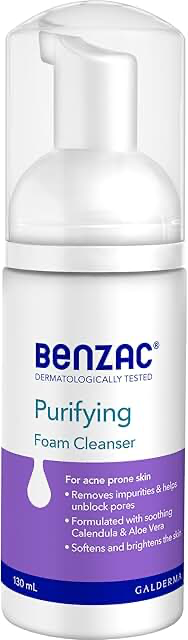
Benzac Purifying Foam Cleanser 130ml, for Acne Prone Skin
Benzac Purifying Foam Cleanser 130ml is a rinse-off facial cleanser in the Benzac range. The Australian manufacturer also uses the name Daily Facial Foam Cleanser in its directions. Its published ingredient list contains no benzoyl peroxide: the Benzac brand name alone does not make it equivalent to a Benzac AC acne medicine.
Research reviewed 13 October 2026. Tanrub has not personally tested this product. As an Amazon Associate I earn from qualifying purchases.
Exact product and pack
| Reference product | Benzac Purifying Foam Cleanser, 130ml |
|---|---|
| Alternate brand wording | Daily Facial Foam Cleanser |
| Listing identifier | |
| Use format | Rinse-off cleansing step, before any separately selected acne treatment |
| Not the same as | Benzac AC 5% Wash, Benzac AC gels, pH Control Antibacterial Wash or a facial scrub |
The original Tanrub catalogue records this ASIN and 130ml pack. An exact-ASIN retailer index corroborates the Daily Facial Foam Cleanser identity, while the official Australian page identifies Purifying Foam Cleanser. This matches the product family, but a historical catalogue or an indexed listing cannot establish a particular current seller’s bottle formula or storage history.
Complete Australian manufacturer ingredient list
The following is the factual ingredient declaration published on the Australian Benzac page, with capitalisation normalised:
Aqua, Disodium Laureth Sulfosuccinate, Cocamidopropyl Betaine, Sodium C14-16 Olefin Sulfonate, Propylene Glycol, PEG-150 Distearate, Alcohol, Aloe Barbadensis Leaf Extract, Benzyl Salicylate, Calendula Officinalis Flower Extract, Citric Acid, Hexylcinnamal, Magnesium Chloride, Magnesium Nitrate, Methyl Gluceth-20, Methylchloroisothiazolinone, Methylisothiazolinone, Methylparaben, Sodium Chloride, Sodium Hydroxide, Tetrasodium EDTA, CI 42090, Perfume.
Concentrations, measured finished-product pH and a formula revision code are not supplied on the reviewed Australian page. Citric acid or sodium hydroxide appearing in a list does not establish a numerical pH. Do not describe the cleanser as containing a therapeutic percentage of salicylic acid: benzyl salicylate is a different ingredient name, and salicylic acid itself is not declared here.
What the formula means for shopping
| Declaration | Practical interpretation |
|---|---|
| Perfume, benzyl salicylate and hexylcinnamal | The Australian reference formula should not be described as fragrance-free. A marketplace scent field is less specific than the full ingredient list. |
| Alcohol | Alcohol is explicitly declared. Neither its concentration nor a finished-product drying-effect measurement is published here. |
| Aloe and calendula extracts | These are present in the declaration. Their presence alone does not prove tolerance, a particular concentration or an acne-treatment effect. |
| Methylchloroisothiazolinone and methylisothiazolinone | MI/MCI preservative names matter when checking a previously diagnosed ingredient allergy. Rinsing does not make the ingredient declaration irrelevant. |
| CI 42090 | The list declares this colour ingredient. It is another reason to check the actual label rather than assuming every Benzac cleanser has the same formula. |
Regional formula differences
The Malaysian manufacturer page describes a 130ml Purifying Cleanser with a substantially different declaration. Its full list is:
Aqua, Sodium Trideceth Sulfate, Cocamidopropyl Betaine, Sodium C14-16 Olefin Sulfonate, Alcohol, Aloe Barbadensis Leaf Extract, Buteth-3, Calendula Officinalis Flower Extract, CI 14720, CI 42090, CI 60730, Citric Acid, Disodium Cocoyl Glutamate, Isopropyl Alcohol, Magnesium Chloride, Magnesium Nitrate, Methyl Gluceth-20, Methylchloroisothiazolinone (and) Methylisothiazolinone, Methyl 4-Hydroxybenzoate, Olivamidopropyl Betaine, Parfum, PEG-40 Hydrogenated Castor Oil, Polyquaternium-10, Propylene Glycol, Sodium Acetate, Sodium Benzotriazolyl Butylphenol Sulfonate, Sodium Chloride, Sodium Hydroxide, Sodium Sulfate, Tetrasodium EDTA, Tributyl Citrate, Tris (Tetramethylhydroxypiperidinol) Citrate.
This is a Malaysian reference, not a replacement Australian formula. The different first surfactant and three colour declarations are useful label comparison points. Do not combine these lists or assume that shared name, volume and aloe/calendula claims prove identical contents.
Directions and contact time
The Australian manufacturer describes morning and evening use: wet the skin, massage the cleanser with hands, rinse, and gently dry before the next routine step. It also mentions cleansing the neck. The reviewed directions do not specify an amount per pump, a fixed massage duration or a leave-on interval. Benzac AC gel’s initial two-hour contact instructions must not be transferred to this wash.
Use the directions on the selected bottle. There is no reason to invent a one-minute or two-minute contact rule for a guide when the product source supplies none.
Manufacturer claims and research limits
Benzac describes the product as dermatologically tested for acne-prone skin and claims cleansing and oil control without drying. The reviewed official page does not publish the sample size, comparator, duration, adverse-event count or numerical results behind those claims. These phrases therefore remain manufacturer descriptions rather than independently verified outcomes.
No finished-product controlled trial is cited on the reviewed product page. Research or marketing for Benzac’s benzoyl peroxide gels cannot establish the efficacy of this different formula. Nor do individual aloe, calendula or surfactant findings prove that this bottle clears acne, repairs the barrier or suits everyone with sensitive skin.
MI/MCI: relevant ingredient safety evidence
The European Commission’s Scientific Committee on Consumer Safety assessed methylisothiazolinone sensitisation in 2015. It did not support 100ppm MI in rinse-off cosmetics for induction of contact allergy, and considered 15ppm (0.0015%) acceptable for that specific assessment. The opinion also raised concerns about higher rinse-off exposures. This is ingredient-level risk assessment, not a clinical test of Benzac or proof of its preservative concentration.
EU Regulation 1003/2014 addressed the MI/MCI mixture in a 3:1 ratio at up to 0.0015% in rinse-off cosmetics, with skin-sensitisation potential remaining relevant. This historical EU measure is contextual evidence, not a claim about Australian legal compliance or the actual ratio in this cleanser. Benzac’s reviewed ingredient page does not disclose either percentage.
Precautions and routine decisions
If you already have diagnosed MI/MCI or fragrance allergy, compare this declaration with your clinician’s avoidance list before choosing it. If cleansing produces persistent burning, rash or swelling, stop and seek appropriate medical advice. A foaming texture or acne-prone positioning does not guarantee personal tolerance.
Someone comparing cleansers during benzoyl peroxide treatment should consider the entire routine. The Australian Benzac AC medicine leaflet cautions about additional irritation from harsh cleansers, scrubs and alcohol-containing cosmetics. This cleanser contains alcohol in its reference list; ask a pharmacist about suitability if your treatment routine is already irritating. This is a compatibility question, not evidence that the brand’s cleanser is always unsuitable with its medicines.
Storage, expiry, value and reviews
A numeric storage temperature, shelf life and period-after-opening duration are not published on the reviewed Australian cleanser page. Do not apply the medicine gel’s below-25°C rule as if it were a verified specification for this cleanser. Check the bottle’s storage instructions, expiry or opening symbol; close it securely and protect the dispenser from contamination.
For a confirmed single 130ml bottle, divide total delivered price by 130 and multiply by 100 for cost per 100ml. Check the selected quantity, seller, country and formula together. Reviews may pool packs and regions. Comments about dispenser function or fragrance are personal observations; Tanrub has not tested this cleanser, gives no invented performance score and does not freeze a changing review count into the guide.
Frequently asked questions
Does it contain benzoyl peroxide?
Not in the reviewed Australian ingredient declaration. Benzac AC 5% Wash and the AC gels are separate medicines.
Is it alcohol-free or fragrance-free?
Neither description matches the published Australian list. Alcohol and perfume are declared, along with benzyl salicylate and hexylcinnamal.
Is it the same as the Malaysian cleanser?
The names and 130ml volume overlap, but the two official ingredient lists differ. Compare the country-specific label.
How long should it stay on?
The official directions describe rinsing after cleansing, without a fixed timed contact period. Follow the bottle rather than gel instructions.
Sources and verification record
Compare the separately researched Benzac 5% gel, Benzac 2.5% gel and Benzac 5% wash. They differ in active concentration and format.
Reviewed 13 October 2026. Sources establish reference information; the current seller batch remains uninspected.