
TANRUB · PRODUCT GUIDE
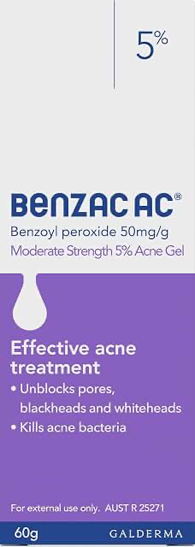
Benzac AC 5% Moderate Acne Gel 60g
Benzac AC Moderate Strength 5% Acne Gel is a benzoyl peroxide medicine. This guide examines the 60g listing, Australian formula and directions, strength comparisons, clinical evidence and regional differences. It is distinct from Benzac’s 5% rinse-off wash and its non-medicated cleansers. Always read the current medicine label and follow directions for use.
Research reviewed 13 October 2026. Tanrub has not personally tested this product. As an Amazon Associate I earn from qualifying purchases.
Exact product identity and registration
| Product | Benzac AC Moderate Strength 5% Acne Gel, listed 60g tube |
|---|---|
| Active concentration | Benzoyl peroxide 50mg/g: 5% by weight |
| Australian registration | AUST R 25271; ARTG record names BENZAC AC 5% benzoyl peroxide 50mg/g gel tube, sponsored by Galderma Australia Pty Ltd |
| Registration date | 15 October 1991, as recorded by the TGA |
| Amazon identifier | ; a listing identifier, not a seller-authenticity certificate |
| Format | Topical gel for affected acne areas; external use only |
The exact ASIN is indexed by Amazon Singapore as the 60g 5% gel. The Australian manufacturer page’s search title and March 2017 medicine leaflet refer to 50g; this older pack reference does not verify the contents of a current seller’s 60g tube. A May 2026 New Zealand datasheet lists 15g, 50g and 60g tubes, noting that availability varies. Confirm the Australian registration, strength, quantity, batch and expiry on the selected pack.
Source 3 · Source 4 · Source 6
Full Australian manufacturer formula
The Australian Benzac product page declares benzoyl peroxide 50mg/g, with this gel base: docusate sodium, disodium edetate, poloxamer 182, carbomer 940, propylene glycol, acrylates copolymer, glycerol, silicon dioxide, purified water and sodium hydroxide for pH adjustment. The March 2017 Australian leaflet also lists silicon dioxide. Percentages of the inactive ingredients and finished-product pH are not disclosed in these sources.
Ingredient roles and regional differences
| Component | What the evidence supports |
|---|---|
| Benzoyl peroxide | Antimicrobial acne active with exfoliative and comedolytic activity, according to the medicine datasheet. |
| Acrylates copolymer | The manufacturer describes oil-absorbing beads; this is a formulation claim, not proof of a guaranteed personal reduction in oiliness. |
| Glycerol | A humectant in the gel base. Its presence does not prevent every episode of irritation. |
| Propylene glycol | A declared excipient; the Australian leaflet specifically flags possible skin irritation. |
| Remaining excipients | Form the medicine’s vehicle. Their quantities and individual contribution to clinical outcomes are not published on the reviewed Australian page. |
The May 2026 New Zealand datasheet lists docusate sodium, disodium edetate, poloxamer 182, carbomer 940, propylene glycol, acrylates copolymer, glycerol, purified water, and citric acid and/or sodium hydroxide. It omits silicon dioxide from that list. These are separately attributed regional disclosures; do not merge them into one supposedly universal formula. The selected tube’s label and leaflet remain the practical reference.
Source 1 · Source 2 · Source 4
Australian directions: gradual introduction
The following summarises the Australian manufacturer instructions rather than creating a personalised regimen. Wash and dry hands, gently cleanse the affected skin and dry it before application.
| Stage | Manufacturer instructions |
|---|---|
| Initial use | Apply a thin film once daily to affected areas. Rinse after two hours, dry and moisturise. |
| After three days | If comfortable, apply in the evening and leave overnight. |
| After seven days | Only if no redness or peeling and improvement remains insufficient, the instructions allow morning and evening use. |
More gel does not mean faster improvement. The Australian leaflet advises a review with a doctor or pharmacist after one month and says not to double a missed application. Seek advice before changing strength or combining acne medicines.
Clinical research: does higher strength work better?
Mills and colleagues reported three double-blind studies involving 153 people with mild to moderately severe acne in 1986. The 2.5% formulation outperformed its vehicle and produced reductions in inflammatory papules and pustules comparable to the 5% and 10% preparations studied. Peeling, redness and burning were less frequent with 2.5% than 10%, but comparable to 5%. The abstract also reports reduced P. acnes and surface free fatty acids after two weeks with 2.5%.
This supports a measured discussion of strength rather than assuming that 5% is twice as effective as 2.5%. It is an older study of particular formulations, not a new test of this ASIN, current seller stock, acne scarring or every acne subtype. Tanrub reviewed the published abstract; it does not invent unpublished trial details.
Manufacturer claims and evidence limits
Benzac’s Australian page advertises an upper bacterial-reduction figure of 94%. A microbiological percentage is not the percentage of users cleared of acne or the percentage of pimples removed. The reviewed product page does not supply enough trial detail alongside that figure to establish its timing, population and relevance to every current pack. This guide therefore reports the claim as manufacturer marketing rather than an independently measured result for the 60g listing.
Precautions, side effects and routine compatibility
The Australian leaflet advises avoiding eyes, lips, mouth and damaged skin; sunlight exposure and irritating scrubs, alcohol-containing cosmetics or other topical acne products need care. Benzoyl peroxide can bleach fabrics. Pregnancy and breastfeeding require discussion with a clinician; the leaflet warns against applying it to the chest during breastfeeding. If swallowed, seek immediate advice from Australia’s Poisons Information Centre on 13 11 26.
The New Zealand datasheet categorises dryness, redness, peeling and burning as very common; itching, stinging and irritant dermatitis as common; allergic contact dermatitis as uncommon. These are regional medicine safety categories, not the measured rate in this Amazon listing’s buyers. Stop if swelling or blistering develops. Breathing difficulty or face, lip or tongue swelling warrants urgent medical help. Do not treat severe reactions as evidence that the medicine is working.
Storage, expiry and pack comparisons
The Australian leaflet specifies a cool, dry place below 25°C, secure from children, with the cap replaced. Reject expired or tampered packs. The New Zealand datasheet gives a 24-month shelf life; that is not a promise of two years after opening or purchase. Follow the expiry printed on your tube.
| Benzac product | Main distinction |
|---|---|
| 2.5% gel 60g | 25mg/g active; lower concentration, not the same strength. |
| This 5% gel 60g | 50mg/g active; gradual gel introduction, then longer contact if tolerated. |
| 5% wash 200ml | Separate rinse-off product; gel directions must not be transferred to it. |
Buying checks and frequently asked questions
Is 5% an antibiotic?
No. The declared active is benzoyl peroxide; no antibiotic is listed in the Australian formula. Combination medicines containing an antibiotic are different products.
Can it replace a moisturiser or sunscreen?
No. It is an acne medicine. Its glycerol content does not make it a substitute for either product.
How do I compare value?
Use the total delivered price divided by 60 to compare price per gram for a confirmed single 60g tube. Do not compare a gel and a wash solely by unit price: contact time and vehicle differ. Check whether a listing includes one tube or a multipack.
What should I look for in reviews?
Confirm strength, pack size and country first. Separate comments on irritation, texture and packaging from treatment outcomes. Reviews may be pooled across variants; Tanrub has not personally tested the medicine and does not assign it a changing star rating.
Sources and verification record
Reviewed 13 October 2026. Manufacturer information describes a reference product; it does not establish an individual seller’s batch formula, authenticity or storage history.