
TANRUB · PRODUCT GUIDE
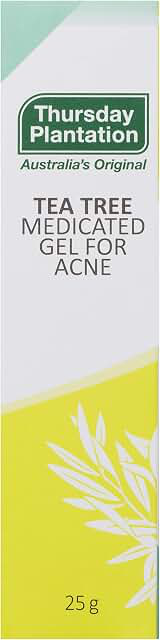
Thursday Plantation Tea Tree Medicated Acne Gel 25g
As an Amazon Associate I earn from qualifying purchases. Tanrub has not personally tested this product. Researched 13 October 2026.
Exact medicated gel
Thursday Plantation Tea Tree Medicated Gel for Acne, 25g, is the leave-on product recorded under ASIN. It declares Melaleuca oil 200mg/g. This is not the rinse-off face wash, anti-fungal gel, antiseptic cream or pure tea tree oil bottle.
| Active | Melaleuca oil 200mg per gram: equivalent to 20% by weight. |
|---|---|
| Alcohol declaration | 12% v/v on the manufacturer’s caution panel. |
| Pack | 25g tube. Calculated declared oil content is 5g across a full 25g tube; this is not a suggested dose. |
| Australian reference | ARTG 55740, currently shown with licence category LI and status A. |
| Routine position | Small amount on affected areas after cleansing; not a rinse-off cleanser. |
Ingredients: verified declarations and remaining gap
Declared active: Melaleuca Oil 200mg/g. Separately declared: Alcohol 12% v/v.
The manufacturer page publishes the active rather than a complete excipient list. The complete TGA public-summary PDF could not be retrieved during this review, so the inactive base is not filled in from guesswork or another country’s formula. This is an explicit research gap; the two declarations above are not presented as the entire composition.
The brand’s “100% pure Australian-grown tea tree oil” wording describes its oil ingredient. The finished gel is 20% oil by weight, not 100% oil. Alcohol’s volume-based percentage cannot simply be subtracted from the oil’s weight-based percentage to calculate the rest of the formula.
Australian register and historical label issue
The public ARTG record names Homart Wellness Aust Pty Ltd as sponsor. Inclusion in the register is a product identity/regulatory reference; it does not establish that this gel outperforms another treatment.
A linked historical Section 14 consent, CON-991, concerned a medicine name interrupted by additional information and background text on labels. Its published period ended on 1 October 2026. This is a dated labelling consent, not a notice that the gel’s ingredients were found unsafe. It cannot establish whether a seller’s current packaging complies; check the delivered Australian label and current manufacturer advice if that is in doubt.
Clinical evidence and limitations
Malhi and colleagues studied a 200mg/g tea tree gel together with a 7mg/g wash, twice daily for 12 weeks. Eighteen people enrolled and fourteen completed; mean lesion counts fell from 23.7 to 10.7. The study was open-label and uncontrolled, with peeling, dryness and scaling reported. It cannot separate the two products’ effects or establish superiority over standard care. The abstract does not establish that every current seller batch matches the study formulations.
The study gel strength matches the declared 200mg/g active here, which makes it more relevant than a trial of a different concentration. It still does not prove current formula continuity or the effect of gel alone. Four enrolled people did not complete the pilot; the absence of serious events in a small sample is not a universal safety guarantee.
The older 1990 trial compared 5% tea tree gel with 5% benzoyl-peroxide lotion in 124 patients. Both improved acne, but tea tree acted more slowly. Five percent is a different concentration from this product’s 20%; that study cannot supply an equivalent dose or establish that a higher percentage is better.
How to apply
The manufacturer directs thoroughly cleansing, then gently applying a small amount to affected areas morning and night. It does not supply a measured gram dose or a clearing-time guarantee. This gel is left on; the face wash’s rinse instruction must not be transferred to it.
Check the foil seal at the tube mouth before first use. Do not use if it is broken. Keep the cap closed between applications, and avoid adding undiluted oil or other treatments to the tube. A larger layer is not a verified route to faster improvement.
Safety and tolerance
The label guidance is external use only, test a small area before use, discontinue for sensitivity, avoid eyes and broken skin, and keep away from children.
NCCIH notes that topical tea tree products can cause irritation, particularly when old or exposed to heat, light or air. Tea tree oil must not be swallowed. This general advice supports checking storage and tolerance; it does not prove this particular product is safe for every user.
Because it combines a concentrated essential oil active with alcohol, assess the whole formula and your previous reactions. “Free from benzoyl peroxide” is not the same as proven free from adverse effects. Do not assume occluding it under a patch or mixing it with another spot medicine has been tested. Seek advice for persistent acne, significant irritation or worsening painful lesions.
Storage and buying checks
Follow the temperature, expiry and opening-life instructions on your actual tube; no exact limits were verified in the manufacturer text reviewed. Heat, light and air matter for tea tree quality, so keep the original tube properly closed and avoid old or poorly stored stock.
Confirm 25g, the medicated acne name, intact seal, seller, total delivered price and Australian label details. Value per gram is cost divided by 25 for one matching tube. A cream, face-wash bottle or acne kit requires a separate calculation. Reviews of those variants cannot determine this gel’s efficacy.
Frequently asked questions
Is 200mg/g the same as 20%?
Yes, by weight: 200mg of active in 1,000mg of gel. It is not 20% alcohol or a measured per-application dose.
Does the brand disclose all inactive ingredients online?
The reviewed product page does not. That gap remains open in this guide.
Does its register entry mean a clinical cure is guaranteed?
No. Read the trial design and limits separately from regulatory identity.
Can I use face-wash instructions for the gel?
No. They are different formats with different exposure.
Sources and review date
- Manufacturer 25g gel page — active, alcohol, use and seal warning.
- TGA ARTG 55740 — current public product entry; full-summary excipients remain unverified.
- TGA historical CON-991 — labelling issue and stated consent period.
- Bassett and colleagues, 1990 — separate 5% formulation study.
- Malhi and colleagues, 2017 — paired gel-and-wash pilot, electronically published in 2016.
- NCCIH tea tree oil evidence and safety — general guidance, updated April 2025.
Reviewed 13 October 2026. Formulas and seller stock can change. General product research does not replace individual healthcare advice.