
TANRUB · PRODUCT GUIDE
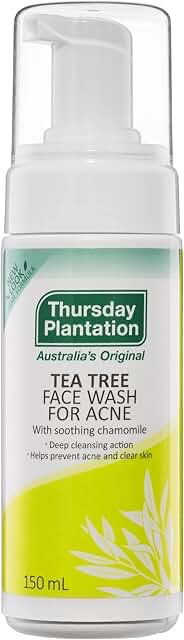
Thursday Plantation Tea Tree Face Wash 150ml
As an Amazon Associate I earn from qualifying purchases. Tanrub has not personally tested this product. Researched 13 October 2026.
The exact 150ml face wash
This is Thursday Plantation Tea Tree Face Wash for Acne, 150ml, ASIN. It is the foaming, soap-free rinse-off cleanser. The brand also sells a 236ml Tea Tree Gel Face Wash with a different published composition. A similar range name does not make these the same formula.
| Selected format | Foaming face wash, 150ml. |
|---|---|
| Purpose | Cleansing excess surface oil, dirt and makeup; manufacturer positions it for combination/oily skin. |
| Treatment distinction | Not the brand’s 25g leave-on medicated gel or undiluted essential oil. |
| Concentration gap | The current 150ml manufacturer page does not declare a tea tree percentage. |
| pH | Brand says pH balanced but supplies no numeric value in the reviewed page. |
Complete manufacturer ingredient list
Water, Cocamidopropyl Betaine, Decyl Glucoside, Chamomilla Recutita (Matricaria) Flower Extract, Alcohol, Melaleuca Alternifolia (Tea Tree) Leaf Oil, Sodium Hydroxymethylglycinate, Eucalyptus Citriodora Oil. Contains Limonene.
This list is published for the 150ml face wash, including in the brand’s acne-kit ingredient section. It contains alcohol and essential oils. The wording about no synthetic fragrance does not mean there are no aromatic ingredients. Ingredient order cannot establish the exact tea tree concentration or individual tolerance.
Ingredient roles
| Cocamidopropyl betaine and decyl glucoside | Cleansing surfactants. Soap-free does not mean there are no cleansing agents. |
|---|---|
| Tea tree and eucalyptus oils; limonene | Aromatic components to consider if similar botanicals have irritated your skin. |
| Chamomile extract | A botanical component; its presence cannot guarantee that the whole cleanser is soothing for you. |
| Alcohol | Listed without a percentage here. Do not copy the medicated gel’s 12% alcohol figure to this wash. |
| Sodium hydroxymethylglycinate | A listed preservative component. The natural positioning of the range is not a complete ingredient-safety assessment. |
What the research can and cannot show
Malhi and colleagues studied a 200mg/g tea tree gel together with a 7mg/g wash, twice daily for 12 weeks. Eighteen people enrolled and fourteen completed; mean lesion counts fell from 23.7 to 10.7. The study was open-label and uncontrolled, with peeling, dryness and scaling reported. It cannot separate the two products’ effects or establish superiority over standard care. The abstract does not establish that every current seller batch matches the study formulations.
The research wash concentration of 7mg/g is information about that study’s formulation. It is not a currently verified label claim for every 150ml bottle, and it cannot be transferred to the 236ml cleanser. Cleansing performance and an acne-treatment outcome are also different questions. No independent success percentage is assigned to this wash.
A separate 1990 single-blind randomized trial in 124 patients compared a 5% tea tree gel with 5% benzoyl-peroxide lotion. Both improved acne, with slower action for tea tree. Those were leave-on products, so that evidence does not establish the efficacy of a briefly rinsed cleanser.
Directions and routine placement
The 150ml brand directions specify wetting the face, lathering, gently massaging away from the eyes, then rinsing well and patting dry. No numeric contact time is provided. Do not leave the cleanser on as a mask or treat its foam as a sign that more washing is necessary.
Follow with a moisturiser you tolerate and retain daytime sun protection. The manufacturer suggests its toner and face cream, but a recommendation to pair products is not evidence that every user needs the complete range. Avoid introducing several new tea tree products at once if you are trying to understand tolerance.
Precautions
The manufacturer specifies external use, testing a small area first, stopping for sensitivity, avoiding eyes and broken skin, and keeping away from children.
NCCIH notes that topical tea tree products can cause irritation, particularly when old or exposed to heat, light or air. Tea tree oil must not be swallowed. This general advice supports checking storage and tolerance; it does not prove this particular product is safe for every user.
Natural origin and absence of benzoyl peroxide do not establish an irritation-free alternative. If washing leaves persistent burning, worsening redness or marked tightness, review your use rather than increasing it to “dry out” a breakout. Painful deep lesions or acne that persists should be assessed professionally.
The 236ml gel is a separate formula
The current 236ml manufacturer page lists a lauryl-sulfate ingredient and fragrance, whereas the 150ml reference uses the betaine/glucoside formula above. Do not transfer the smaller product’s exclusions or ingredient list to the larger bottle. Read the product name, volume, dispenser and actual label together.
The 25g medicated gel is another separate format: it remains on the skin and declares an active concentration. Comparing all three merely by the words “tea tree acne” would miss those differences.
Storage, pack and price checks
Use the physical pack’s expiry and storage instructions. No numeric storage temperature or period after opening was established here. Keep the dispenser and cap clean, protect the pack from avoidable heat, and do not assume an old bottle has unchanged quality.
Confirm a single 150ml bottle, seller and delivered cost. Divide cost by 150 for price per millilitre. Reviews can be useful for the pump, lather or skin feel when they identify the correct formula; changing ratings and comparisons involving another cleanser are not permanent test results.
Frequently asked questions
Is it alcohol-free?
No. Alcohol appears in the published 150ml list.
Does “100% pure tea tree oil” mean the wash is pure oil?
No. That describes the oil ingredient’s purity, not its proportion in a water-based cleanser.
Can I substitute the 236ml bottle without checking ingredients?
Its current published formula differs. Compare the delivered labels.
Sources and review date
- 150ml manufacturer page — exact pack, use, cautions and composition.
- Manufacturer kit composition — separately identifies the 150ml wash.
- 236ml gel manufacturer page — separate formula.
- Bassett and colleagues, 1990 — different leave-on treatment comparison.
- Malhi and colleagues, 2017 — paired gel-and-wash pilot, electronically published in 2016.
- NCCIH tea tree oil evidence and safety — general guidance, updated April 2025.
Reviewed 13 October 2026. Formulas and seller stock can change. General product research does not replace individual healthcare advice.