
TANRUB · PRODUCT GUIDE
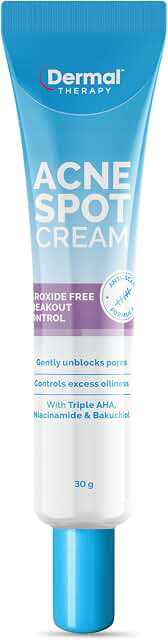
Dermal Therapy Acne Spot Cream 30g
A targeted cream for active spots, rather than an all-over daily moisturiser. This guide examines the 30g listing, complete manufacturer declaration, three AHAs, colloidal sulfur, niacinamide and bakuchiol, and separates product marketing from published ingredient research.
Research reviewed 13 October 2026. Tanrub has not personally tested this product. As an Amazon Associate I earn from qualifying purchases.
Product identity and specifications
| Detail | What can be established |
|---|---|
| Brand and product | Dermal Therapy Acne Spot Cream |
| Recorded quantity | 30g in Tanrub’s supplied catalogue and Australian pharmacy listing; not 30ml. |
| Use | Targeted application to spots or lesions when needed, according to the brand. |
| Market reference | Australian manufacturer information; the page displays an Australian Made claim. |
| Separate products | Acne Control Wash, Acne Control Lotion and Acne Control Clear Patch are different formats. |
A product name and ASIN do not authenticate the seller or establish the precise formula revision in every tube. Confirm the actual 30g pack, batch, country and label.
Directions and frequency
The manufacturer says to apply to spots or lesions only when needed, morning and night. Its routine places the wash first, this spot cream on affected areas, and the lotion afterwards. The brand FAQ says to stop the spot cream once the breakout has healed, rather than using it routinely to prevent all future spots. Follow the current tube if its instructions differ.
The reviewed directions do not provide a numeric amount, a timed wash-off interval or a guaranteed overnight-clearance period. Do not turn the word overnight in a page title into a one-night efficacy promise.
Complete manufacturer ingredient declaration
Water (Aqua), Colloidal Sulfur, Polyacrylate Crosspolymer-6, Niacinamide, Pentylene Glycol, Propanediol, Hydroxyethylcellulose, Glycolic Acid, Sodium PCA, Alpha-Arbutin, Potassium Azeloyl Diglycinate, Lactic Acid, Bakuchiol, Dipotassium Glycyrrhizinate, Allantoin, Cyclopentasiloxane, Cyclohexasiloxane, Citric Acid, Glyceryl Caprylate, Sodium Magnesium Silicate, Xanthan Gum, Acacia Senegal Gum, Bisabolol, Aloe Barbadensis Leaf Juice Powder, Maclura Cochinchinensis Leaf Prenylflavonoids, Silver Citrate, Maltodextrin, Disodium Phosphate, Sodium Phosphate, Polysorbate 60, Sodium Hydroxide, Dehydroacetic Acid, Benzyl Alcohol, Farnesol.
This is the factual list from the manufacturer’s spot-cream page, reproduced in the same order. The kit page also publishes a matching spot-cream declaration. Concentrations of sulfur, niacinamide, the AHAs, alpha-arbutin, bakuchiol and silver are not provided there. Neither measured finished-product pH nor a formula revision code is disclosed. Ingredient order does not supply those missing measurements.
What the key ingredients tell you
| Ingredient or feature | Supported interpretation and limits |
|---|---|
| Glycolic, lactic and citric acids | The three AHAs named in the brand FAQ. Their individual percentages and free-acid activity are not established. |
| Colloidal sulfur and silver citrate | Declared ingredients associated with the brand’s breakout-care positioning. No sulfur or silver dose is disclosed; do not substitute research on a 10% sulfur ointment. |
| Niacinamide | Declared vitamin B3 ingredient. The 4% concentration in published acne studies is not verified for this cream. |
| Alpha-arbutin and bakuchiol | The brand links them to its anti-scar positioning. Presence alone does not establish correction of pitted or raised acne scars. |
| Maclura cochinchinensis leaf prenylflavonoids | A declared botanical component. The brand discusses Seboclear technology; the INCI list does not reveal the percentage of a trade-name blend. |
| Potassium azeloyl diglycinate | That is the declared ingredient name, rather than azelaic acid. Do not treat it as a verified 15% or 20% azelaic-acid medicine. |
| Benzyl alcohol and farnesol | Both are listed. An unqualified alcohol-free description would obscure the actual declaration; benzyl alcohol is a different name from ethanol or Alcohol Denat. |
Source conflict: is the cream acid-free?
The manufacturer range copy includes broad language about being free from acid, while the spot cream’s own declaration lists glycolic, lactic and citric acids. Its FAQ explicitly calls those three AHAs. The specific formula is the more useful reference for this product. This guide therefore does not describe the spot cream as acid-free.
The reviewed spot-cream declaration does not list salicylic acid or benzoyl peroxide. Absence of those particular ingredients should not be expanded into absence of every acid, absence of irritation risk or proof of equivalent performance to a medicine containing them.
Manufacturer claims and finished-product evidence
The brand presents this cream as clinically tested, sebum-controlling and designed with an anti-scar formula. The reviewed product and FAQ pages do not publish enough finished-cream trial detail to independently establish participant numbers, comparator, dose, duration, quantified scar change or a guaranteed clearance timeline.
Testimonials and customer ratings are individual reports, not controlled trials. A technology or ingredient study cannot be silently relabelled as a trial of the complete 30g product. Likewise, pigmentation, pore appearance and structural scarring are distinct claims; the reviewed material does not establish elimination of every type of acne mark or scar.
Published niacinamide and bakuchiol research
| Study | Design and finding | What it does not establish here |
|---|---|---|
| Shalita et al., 1995 | 76 people randomised to 4% nicotinamide or 1% clindamycin gel, twice daily for eight weeks. Both improved inflammatory acne; between-group differences in reported outcomes were not statistically significant. The paper notes partial industry support. | This was not Dermal Therapy cream, and its 4% dose is not confirmed in this product. |
| Khodaeiani et al., 2013 | 80 people with moderate inflammatory facial acne, randomised double-blind to 4% nicotinamide or 1% clindamycin twice daily. Acne grades improved in both groups over eight weeks without a significant overall between-group difference; subgroup findings differed by skin type. | A different gel study does not prove this multi-ingredient spot cream has the same effect or can replace prescribed treatment. |
| Dhaliwal et al., 2019 | 44 participants in a double-blind 12-week photoageing study: 0.5% bakuchiol twice daily versus 0.5% retinol daily. Wrinkle area and hyperpigmentation improved in both groups; retinol users reported more scaling and stinging. | Photoageing is not an acne-scar trial. The bakuchiol concentration and vehicle differ or remain unknown here. |
These primary studies provide context for ingredient interest. None is a head-to-head trial of this exact ASIN, a seller’s current tube or the manufacturer’s complete three-product regimen. This review uses published abstracts; it does not invent unpublished protocol details.
Source 4 · Source 5 · Source 6
Precautions, AHA sun sensitivity and routine compatibility
FDA guidance notes that topical AHA cosmetics can increase sun sensitivity during use and for up to a week after stopping. It recommends sunscreen, protective clothing and limited sun exposure during that period. This is general AHA guidance, not a measurement of this cream’s specific risk, and the product page does not supply the percentages or pH needed to quantify that risk. No SPF protection is established for this spot cream.
Persistent stinging, rash or swelling should not be dismissed as evidence of successful treatment. Check a known allergy avoidance list against the whole formula. If using prescribed acne treatment, ask the prescriber how this additional acid-containing product fits into your routine; the brand FAQ itself advises speaking to a doctor about prescription combinations.
A product-specific minimum age or pregnancy/breastfeeding assessment was not established from the reviewed pages. Ask a qualified clinician with the actual label rather than deriving suitability from marketing or an ingredient’s position in the list.
Introducing it into a routine
The AAD recommends testing a new skincare product on a small area, using the normal amount, twice daily for seven to ten days. Follow the product’s normal contact instructions. Stop and wash it off if a reaction develops; significant reactions may need clinical review. Such a home trial can help reveal intolerance, but does not diagnose an allergy or guarantee future tolerance.
Introduce one change at a time so any reaction is easier to relate to the product. The manufacturer’s targeted-use instructions do not mean covering the entire face with the spot cream is required. This product and the separate lotion have different jobs.
Certification, packaging and environmental claims
The manufacturer’s page displays Australian Made positioning. Vegan, organic, Leaping Bunny approval, an exact recycled-plastic percentage and an exact recycling pathway were not verified for this pack. Those are separate matters and should not be inferred from botanical ingredients or local manufacture. Check pack disposal guidance and local collection rules.
Buying, price and authenticity checks
Confirm the 30g spot cream, quantity of tubes, seller and delivered price. A kit containing a smaller spot cream and other items is a different value comparison. Divide the total delivered price by the total confirmed grams and multiply by 100 for cost per 100g. For example, a hypothetical $15 delivered 30g tube costs $50 per 100g; this is arithmetic, not a current price.
Review pooling can mix products or sizes. Prioritise descriptions of the exact pack, dispenser, texture and personal reaction, while recognising that experiences do not predict your result. An ASIN, barcode or attractive photograph alone does not establish authenticity or correct storage.
Storage, expiry and unanswered pack details
A verified storage temperature, shelf life, period-after-opening duration and batch-decoding method were not supplied on the reviewed manufacturer page. Follow the tube’s own instructions and expiry/opening symbol. Do not borrow the shelf life of a sulfur medicine or another Dermal Therapy product.
The important open specifications are ingredient concentrations, measured pH, a dated finished-product trial protocol and the current seller’s back label. This guide states those gaps rather than substituting assumptions.
Frequently asked questions
Is it a 10% sulfur treatment?
No 10% concentration was verified. Colloidal sulfur is declared without a percentage.
Does it contain three AHAs?
The formula and brand FAQ name glycolic, lactic and citric acids. That conflicts with applying general acid-free range language to the spot cream.
Will it remove acne scars?
The manufacturer markets an anti-scar formula, but the reviewed evidence does not prove removal of pitted or raised scars by this finished cream.
Is niacinamide present at 4%?
It is present in the declaration, but the manufacturer does not disclose its concentration. Published 4% gel trials do not supply that missing fact.
Should it replace my daily moisturiser?
The brand positions it for spots when needed and supplies a separate Acne Control Lotion for the moisturising step.
Can I expect every spot to disappear overnight?
No such guaranteed timeline is established in the reviewed evidence.
Sources and verification record
Accessed 13 October 2026. Manufacturer sources establish reference formula and positioning. Original trials concern particular ingredient preparations. Dermatology and regulator sources provide general precautions. Current seller stock remains uninspected.
- Dermal Therapy: spot cream formula, directions and claims
- Dermal Therapy FAQ: three AHAs, targeted use and prescription advice
- Manufacturer kit: matching spot-cream formula and separate components
- Shalita et al., 1995: 76-person nicotinamide comparison
- Khodaeiani et al., 2013: 80-person nicotinamide trial
- Dhaliwal et al., 2019: bakuchiol photoageing trial
- FDA: AHA sun-sensitivity guidance
- AAD: testing skincare products
- Australian pharmacy: 30g product identity