
TANRUB · PRODUCT GUIDE
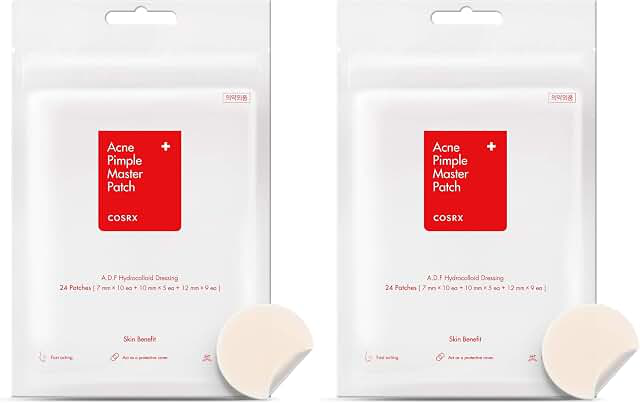
COSRX Acne Pimple Master Patch 24 Pieces Pack of 2
COSRX Acne Pimple Master Patch is a hydrocolloid dressing-style patch available in three sizes. This guide covers the listing recorded as 24 patches per pouch, pack of two, ASIN. It includes the full manufacturer material declaration, separates retail details from brand specifications, and explains the limits of the clinical evidence.
Research checked 13 October 2026. This is a source-based guide, not a personal product test. As an Amazon Associate I earn from qualifying purchases.
Product at a glance
| Product | COSRX Acne Pimple Master Patch, original format |
|---|---|
| Listing | , 24 patches × 2 pouches |
| Expected total | 48 patches if the selected offer supplies two standard 24-patch pouches |
| Material category | Hydrocolloid; seven named manufacturer materials listed below |
| Size references | Three sizes; official counts corroborate retailer-listed 7mm, 10mm and 12mm arrangement |
| Wear time | No fixed hourly maximum verified on the reviewed brand page; follow actual pack |
| Research status | Hydrocolloid class evidence exists; no published trial of this exact COSRX two-pack verified |
Two-pack identity and count checks
The exact-ASIN retail record names “24 Patches (Pack of 2)” and records two items. The manufacturer’s standard pouch contains 24 patches, so the expected total is 48. Confirm that two sealed pouches arrive rather than relying on a marketplace’s single ambiguous “24” field.
The listing’s fluid-ounce field is not a meaningful measurement of the number of patches. Count and patch size are the useful comparisons. Do not use shipping weight or a liquid-volume field as proof of total dressing area or product dose.
Sizes and the count in each pouch
| Retailer-listed diameter | Brand-confirmed size category | Per standard pouch | Expected two-pouch total |
|---|---|---|---|
| 7mm | Small | 10 | 20 |
| 10mm | Medium | 5 | 10 |
| 12mm | Large | 9 | 18 |
| Total | Three categories | 24 | 48 |
The official product page verifies 10 small, five medium and nine large patches. The numerical diameters are attributed to the Australian retailer reference, not presented as measurements made for this guide. Inspect the selected pack if sizing is important.
Full manufacturer material declaration
Full ingredients as named by COSRX: Petroleum Resin, Cellulose Gum, Styrene Isoprene Styrene Block Copolymer, Polyurethane Film, Polyisobutylene, Liquid Paraffin, Tetrakismethane.
Individual amounts, layer thicknesses and the complete identity behind the final label term were not supplied in the reviewed page. “Tetrakismethane” is retained as the source names it; this guide does not assign it a guessed chemical identity, concentration or toxicity classification.
None of these declared entries is salicylic acid, benzoyl peroxide or tea tree oil. Do not transfer an active ingredient from a medicated COSRX patch to this original product. Check the actual package for a different revision.
Sources: 1
What hydrocolloid does—and does not establish
COSRX describes hydrocolloid as absorbing discharge and maintaining a moist covering. The full list identifies a material system, not a single pure ingredient. Film, gel and adhesive composition matters when comparing products or screening a material allergy.
A patch becoming opaque is consistent with fluid uptake. It is not a measurement of bacterial killing, removal of everything inside a follicle or permanent acne clearance. The amount a dressing absorbs also depends on the blemish and use conditions; no fixed absorption capacity was verified for this product.
Sources: 1
Marketing claims and evidence limits
The manufacturer promotes overnight healing, faster recovery and scar prevention. The reviewed page did not provide a controlled COSRX trial with sample size, comparator, lesion counts or a scar endpoint. Those remain attributed marketing claims rather than verified numerical outcomes.
The exact-ASIN retail copy additionally uses “no irritation,” “clinically designed” and an invisible-patch description. Those phrases do not provide clinical methods or guarantee tolerance. The original material list and product name should take priority over a shortened promotional summary.
No verified head-to-head trial establishes that this patch heals a pimple faster than every competing hydrocolloid patch. Reviews and their automatically generated summary do not fill that evidence gap.
Clinical research on hydrocolloid patches
A randomized 2006 pilot compared 3M Acne Dressing with skin tape in 20 people over one week. The hydrocolloid group had greater improvement in overall acne severity and inflammation. It was a different dressing, not COSRX.
The small study cannot supply a COSRX response percentage, long-term scar-prevention rate or exact wear schedule. Its UVB transmission findings also do not establish an SPF or broad-spectrum sunscreen claim for this product.
AAD advice recognises hydrocolloid patches as a way to protect skin and support healing. That general guidance does not mean every deep lesion releases fluid into a patch or that a covering replaces an assessment for persistent nodular or cystic acne.
Application and routine placement
- Follow the delivered pack. The manufacturer’s page instructs cleansing the area around the blemish.
- Choose a patch larger than the problem spot so it can cover the area.
- Attach it to the spot. The retailer reference advises dry skin before other products.
- Use a fresh patch when replacing a used one; check the actual pack for removal and replacement directions.
A lotion or treatment under the adhesive can conflict with applying it directly to clean skin. No controlled compatibility protocol for covering an acid serum, retinoid or benzoyl peroxide treatment was verified. Do not add those underneath simply to increase treatment strength.
Wear time and replacement uncertainty
The reviewed brand page gives application instructions but no fixed hourly maximum. Retail guidance refers to overnight use or changing a patch when it turns white. This guide does not borrow a six- or eight-hour limit from another brand and present it as a COSRX instruction.
Follow the current pack’s wear and replacement directions. Colour change is an observation of the patch, not proof that the lesion is completely healed. Keeping the same sticker on indefinitely or reusing a removed sticker was not supported by the verified manufacturer information.
Picking, deep pimples and scar claims
Some retailer copy discusses application to a popped or leaking pimple. That is not a reason to deliberately squeeze a blemish. AAD advice specifically warns that picking or squeezing deep acne can increase infection, discolouration and scarring risks.
If a deep painful pimple persists or several develop, seek dermatological care. A protective covering and treatment of the underlying acne have different roles. The manufacturer’s scar-prevention wording is not proof that every existing or future scar will be prevented.
Safety and material-allergy checks
The Australian retailer advises stopping and seeking advice for redness, swelling or irritation. A seven-material declaration can help screen known exclusions, but no verified latex-free, animal-origin-free or hypoallergenic certification was established for the exact seller pack.
Do not use a broad “all skin types” retail field as an individual safety assessment. Follow warnings on the actual pouch, including exclusions for wounds or inflamed skin. For an adhesive allergy, uncertain wound or a treated skin condition, ask a clinician or the manufacturer rather than inferring suitability from the hydrocolloid category.
Sources: 3
Storage, expiry and package condition
The reviewed manufacturer page did not supply a universal numerical storage temperature, shelf life or after-opening duration. The Australian retailer advises avoiding direct sunlight. Check the actual pouch’s storage and expiry information instead of applying another brand’s specifications.
Confirm that both pouches and backing sheets are intact. Keep the lot and expiry details. The listing’s date-first-available field is not a manufacture date, and a product photograph cannot establish the remaining life of the delivered patches.
Comparing formats and value
| Comparison | Useful check | Limit |
|---|---|---|
| Two-pack versus single pouch | Verified number of 24-patch pouches | Expected 48 requires two actual standard pouches |
| Original versus a thinner daytime format | Full product name, sizes and film design | Visibility does not demonstrate greater healing efficacy |
| Original versus medicated patches | Complete active/material declaration | Do not assign a competitor’s acid concentration to this product |
| Price per patch | Total delivered price ÷ verified total patch count | Different sizes provide different coverage area |
For a different overnight product, see the Hero Mighty Patch Original guide. Brand-specific directions and disclosure gaps should be compared alongside price.
Frequently asked questions
Is this 24 or 48 patches? The listing is recorded as 24 per pouch, pack of two: 48 expected when both standard pouches are supplied.
How many large patches should that include? Two standard pouches imply 18 large patches, from nine in each pouch.
Does it contain salicylic acid? It is not in the reviewed original product’s manufacturer declaration.
Is there a confirmed eight-hour maximum? None was verified on the reviewed brand page. Follow the delivered pack.
Does the white patch prove all acne bacteria are gone? No; fluid uptake is not a bacterial-eradication test.
Is scar prevention proven for this two-pack? No published product-specific scar-prevention trial was verified.
Sources and verification record
- COSRX official: standard 24-patch counts, full seven-material declaration, claims and application
- Exact-ASIN retail reference:, two items and 24-patch pack description
- Kanvas Beauty Australia: attributed diameters, routine and warning/storage reference; retail source
- Chao et al., 2006: primary pilot of a different 3M hydrocolloid dressing; PMID 16688374
- AAD: hydrocolloid protection, no-picking advice and when to seek treatment