
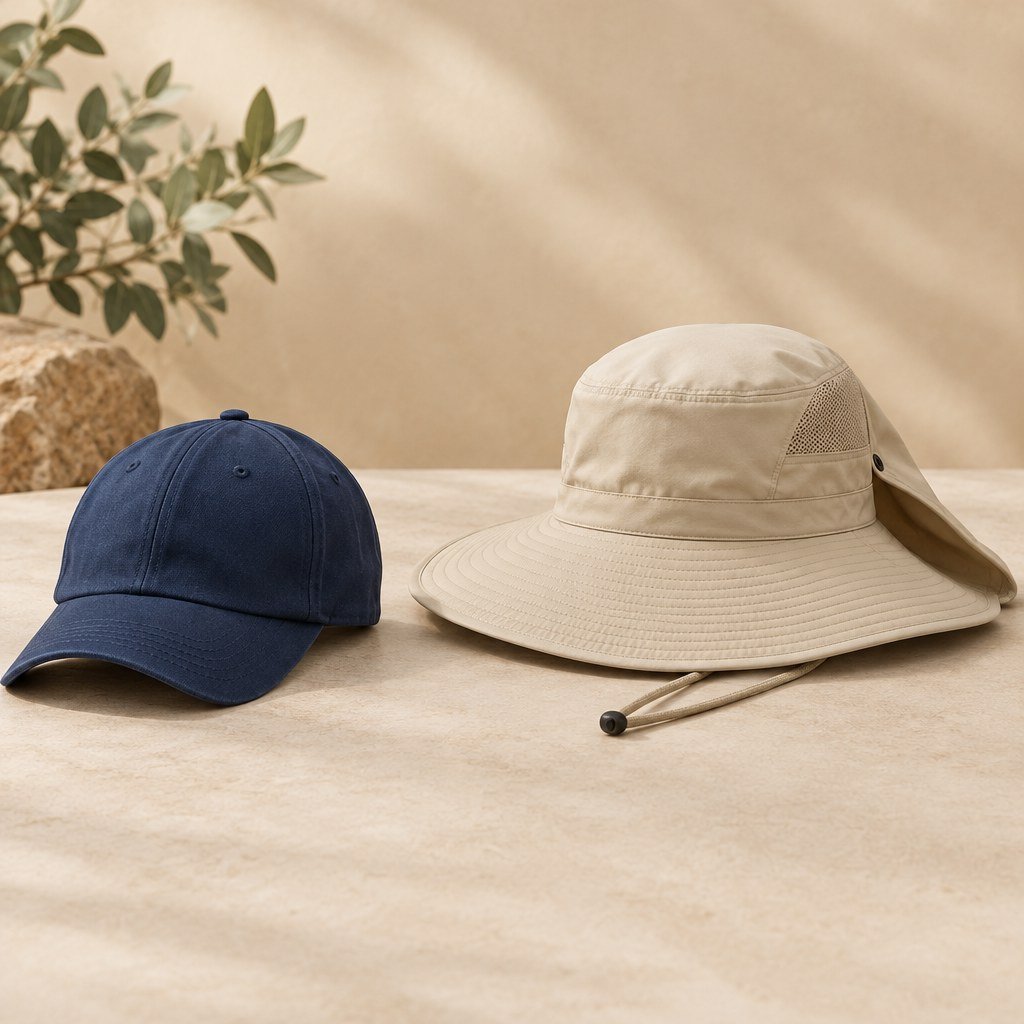
Baseball caps provide some protection against ultraviolet (UV) radiation, particularly for the forehead, scalp and nose. However, they leave the ears, cheeks, chin and back of the neck largely exposed.
Research from the Australian Radiation Protection and Nuclear Safety Agency (ARPANSA) shows that broad-brimmed, bucket and legionnaire-style hats provide more complete protection than ordinary baseball caps. This is why Cancer Council Australia does not recommend baseball caps as a primary form of sun protection.
The bottom line: A baseball cap is better than no head covering for the areas it shades, but it cannot replace a sun-protective hat, sunscreen and other precautions.
How Much UV Protection Does a Baseball Cap Provide?
ARPANSA publishes protection factors (PFs) for four common hat styles. A PF of 4 means approximately one-quarter of the UV reaches the relevant area compared with no hat under the measured conditions. Higher values indicate greater protection.
UV Protection by Hat Type
| Hat type | Forehead | Cheeks | Nose | Ears | Chin | Neck |
|---|---|---|---|---|---|---|
| Baseball cap | 9 | >1 | 4 | >1 | >1 | >1 |
| Broad-brimmed hat | 15+ | 2 | 7 | 6 | >1 | 2 |
| Bucket hat | 15 | 2 | 6 | 7 | >1 | 2 |
| Legionnaire hat | 13 | 3 | 10 | 4 | >1 | >4 |
Source: ARPANSA — Sun Protection Using Hats. Values are protection factors, not percentages. The “>1” notation is reproduced from ARPANSA; it does not establish a precise protection factor.
The measurements show why coverage matters: a cap shades the forehead and part of the nose, but offers little coverage to the sides and back of the head. A hat with a brim around the entire crown generally provides broader protection, while a legionnaire flap helps cover the neck. No hat blocks all UV.
Why Are the Ears, Nose and Neck Important?
The face, ears, scalp and neck are frequently exposed to sunlight. Basal cell and squamous cell carcinomas often develop in these areas, which makes protecting the full head and neck important. Anatomical studies reported in the original research found basal cell carcinomas frequently around the nose, while squamous cell carcinomas were prominent around the ears and scalp.
These studies document where cancers occur; they do not directly demonstrate that baseball-cap wearers develop more cancers than broad-brimmed-hat wearers. The stronger basis for choosing broader hats is measured UV exposure coupled with established knowledge about UV damage.
Why Even Wide-Brimmed Hats Cannot Block All UV
A hat intercepts direct sunlight, but UV radiation can also scatter through the atmosphere or reflect from sand, water, snow and other surfaces. It can therefore reach the face from directions not covered by the brim.
A 2018 modelling study by Backes and colleagues examined predicted UV exposure with several hat styles using a three-dimensional head model. Wider brims generally improved facial protection, but no design eliminated UV exposure at every facial region. Such computer modelling helps explain why complete protection requires more than a hat, although results depend on environmental assumptions and do not measure long-term outcomes.
Does UPF 50+ Make a Baseball Cap Sun-Safe?
UPF means Ultraviolet Protection Factor. UPF 50 fabric allows about one-fiftieth of incident UV radiation to pass through under relevant testing conditions—approximately 98% is blocked. That is useful for the skin covered by the material, but it does not protect ears or neck that remain uncovered.
A cap made from UPF 50+ fabric can protect the scalp underneath its crown while leaving surrounding skin exposed. Fabric rating and hat design are separate considerations.
What a 2025 Study Found
A 2025 study in the Journal of Clinical and Aesthetic Dermatology evaluated hats marketed online in the United States. Most carried sun-protection claims, but not all met the design and material criteria considered by researchers. They emphasized the importance of brim coverage and construction rather than relying on UPF marketing alone. This was a small audit of product listings, not a clinical test of skin-cancer outcomes.
What Type of Hat Provides Better Sun Protection?
1. Broad-Brimmed Hats
A broad-brimmed hat has a brim around the whole head. Cancer Council guidance recommends at least 7.5 cm for adults. This provides more extensive shade to the face, ears and neck than a cap. Choose closely woven fabric and a secure, comfortable fit.
2. Bucket Hats
A suitable bucket hat has a deep crown and a downward-sloping brim. Cancer Council recommends a brim of at least 6 cm for adults. Narrow-brimmed fashion bucket hats may not offer the same protection.
3. Legionnaire Hats
Legionnaire hats combine a front peak with a flap extending over the back and sides of the head. For good coverage, the flap should meet the front peak at the sides. Some facial areas remain exposed, so sunscreen is still important.
| Style | Main strength | Main limitation |
|---|---|---|
| Baseball cap | Forehead and partial nose shading | Ears, cheeks and neck exposed |
| Broad-brimmed | Broad coverage around the head | Indirect UV still reaches skin |
| Bucket | Convenient all-round shade | Depends on brim size and fit |
| Legionnaire | Good neck coverage | Some facial areas remain exposed |
For more detail, see Tanrub’s evidence review of wide-brimmed hats and sun protection.
Can You Make a Baseball Cap Safer in the Sun?
Apply Sunscreen to Exposed Skin
Use broad-spectrum, water-resistant SPF 50 or SPF 50+ sunscreen on exposed skin. Pay attention to the ears, back and sides of the neck, cheeks, temples, nose and uncovered scalp. Cancer Council advises applying sunscreen around 20 minutes before going outdoors and reapplying every two hours, as well as after swimming, sweating or towelling off.
Consider a Neck Flap
A cap with a properly designed flap can improve coverage of the ears and neck, but protection depends on how well the flap fits and the fabric used. Do not assume an untested clip-on flap provides the same protection as a tested legionnaire hat.
Wear Sunglasses and Seek Shade
Choose close-fitting, preferably wraparound sunglasses that meet Australian standards. Use shade where possible, remembering that reflected and scattered UV can still reach the skin.
Check the UV Index
Australian public health advice recommends sun protection when the UV Index is 3 or higher. UV exposure varies with location, time of day, season and surroundings.
Read Tanrub’s related SPF 20 to SPF 100 sunscreen evidence guide.
Are Baseball Caps Better Than No Hat?
For some areas, yes. A baseball cap shades the forehead, covered scalp and part of the nose, reducing direct UV reaching those surfaces. However, it provides uneven protection; ears and neck remain exposed, and reflected or scattered UV can reach under the peak. Wearing a cap with other protective measures is preferable to relying on it alone. For regular outdoor activity, choose a properly designed sun-safe hat.
What Does the Evidence Not Tell Us?
The strongest comparisons between hat styles involve measured or modelled UV exposure, not decades-long studies directly comparing skin cancer rates between baseball-cap wearers and broad-brimmed-hat wearers.
- Protection-factor measurements: The reported values apply under particular conditions and vary with sun angle, brim design and head position.
- Modelling: Simulations explain the impact of direct and diffuse UV but do not capture every situation in daily life.
- Fabric studies: Small laboratory tests show that thickness and weave matter, but do not establish that one commercial cap outperforms every UPF-rated alternative.
- Product listing audits: Online hat descriptions are useful for assessing marketing and design, but do not establish clinical outcomes.
Strong evidence: UV contributes to skin cancer and hat design affects coverage. Practical evidence: Broad-brimmed, bucket and legionnaire hats cover more vulnerable skin than ordinary baseball caps. Limited evidence: The precise difference in long-term skin cancer incidence between people routinely wearing different hat styles.
Frequently Asked Questions
Do baseball caps block harmful UV rays?
Yes. They can block UV reaching the scalp beneath the fabric and shade the forehead and part of the nose. They leave ears, cheeks and neck inadequately protected.
Can you get sunburned while wearing a baseball cap?
Yes. Uncovered skin remains vulnerable, and reflected or scattered UV may also reach shaded areas.
Is a UPF 50+ baseball cap enough?
No. UPF describes how well the fabric blocks UV, not how much uncovered skin the hat protects.
What type of hat gives the best UV protection?
Cancer Council recommends suitably designed broad-brimmed, bucket and legionnaire-style hats covering the face, ears and neck.
Should you wear sunscreen underneath a hat?
Yes. Use broad-spectrum SPF 50 or SPF 50+ sunscreen on exposed skin as part of a combined sun-protection routine.
Does a baseball cap protect a bald head?
The covered scalp benefits from the fabric, but exposed areas near the back or sides of the head may still receive UV. A hat offering more extensive coverage is preferable.
Final Verdict: Are Baseball Caps Sun-Safe?
Baseball caps provide real but limited UV protection. They shade the forehead, part of the scalp and nose but leave important areas—including the ears, cheeks and neck—insufficiently protected. For everyday sun safety, use a properly designed broad-brimmed, bucket or legionnaire hat alongside SPF 50 or SPF 50+ sunscreen, protective clothing, sunglasses and shade.
References and Further Reading
- ARPANSA — Sun Protection Using Hats. Protection-factor comparison and government guidance.
- Cancer Council NSW — Sun Smart Hats. Design recommendations.
- Cancer Council Australia — Sun Protection. National UV prevention guidance.
- Cancer Council Australia — Five SunSmart Steps. Sunscreen, clothing, hats, shade and sunglasses.
- Journal of Clinical and Aesthetic Dermatology (2025) — Hat design and sun protection claims.
- Backes et al. (2018). Modelling research on the predicted sun protection afforded by different hat designs; complete bibliographic details require verification.
- Cutis. Research comparing UV transmission through ordinary and UV-protective materials; complete bibliographic details require verification.
Editorial note: This article provides general health information and is not a substitute for individualized medical advice. More detailed numerical results from less accessible studies in the earlier research notes have been omitted where their complete references could not be verified.
Leave a Reply